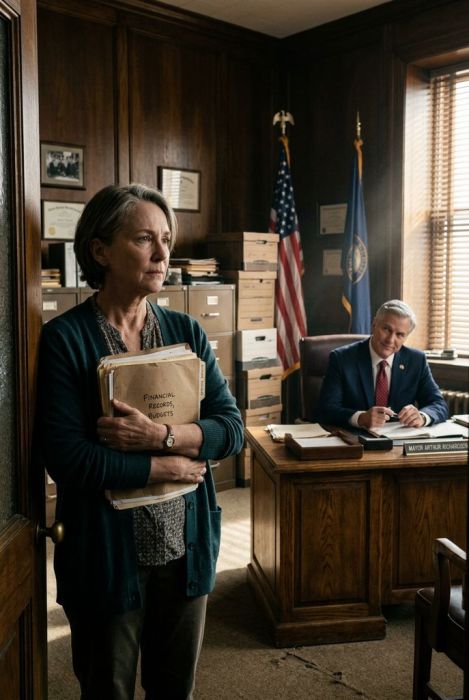
The day the town council voted me out, Mayor Vern Ashford stood at the back of the room and cried. Not for me — he cried for the cameras. An hour earlier, he had slid a typed confession across his desk, my name already at the bottom, and said, "Sign it, Ruth, and we'll never speak of the missing money again." I didn't sign. My second mistake was walking out of that building with a cardboard box of papers nobody thought I'd ever read. My first mistake was being honest in a town that loved a liar.
I had been the treasurer of Sycamore Bend, Ohio, for thirty-one years. I knew every dime that moved through that town hall, every ream of paper, every lightbulb in the library basement. When Frank was alive, he used to tease me about it. "You love those ledgers more than me," he'd say, and I'd kiss his bald head and tell him the ledgers had never once lied to me. Frank died two years ago. He was the only one who could make me laugh about Vern Ashford's handshake, which lingered half a second too long, like he was counting your bills while he held your hand.
Not that anybody else saw it. Vern was Sycamore Bend. He coached the youth soccer league, he bought a new scoreboard for the high school out of his own pocket, he stood in the rain at every Memorial Day service with his hand over his heart. Three terms they gave him. Three terms they adored him. I voted for him twice myself, before I understood what a man with a golden smile and an empty town account actually looks like.
It started with a bridge. The old covered bridge on Route 9 — the one in every postcard of our town — was falling into the creek, and the county said they would match whatever we raised. The town council named it the Centennial Bridge Fund and set a goal of two hundred thousand dollars. Vern made himself chair of the committee, and because I kept the books, I was the one who watched the money move.
The trouble showed up in the invoices. Every month, a company called Bridgerock Consulting Group billed us for "grant administration services." Forty-two thousand dollars over the first year. I asked Vern about it. He smiled his patient smile and said, "Ruth, without Bridgerock we would never have gotten the county's matching money at all. They're the ones who filled out the paperwork. You wouldn't believe how complicated it is." I believed him. I believed him for eleven months.
Then my sister's friend in Toledo looked up Bridgerock for me — just a curious check, the kind I had been doing since my days as a teller at the savings bank — and told me the company did not have a phone number. The address was a mailbox at a UPS store on the other side of the county line. The website was three pages and a stock photo. The president of Bridgerock Consulting Group was a man named Boyd Lambert. Boyd is Vern's wife's brother.
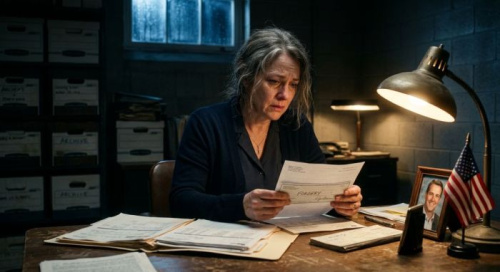
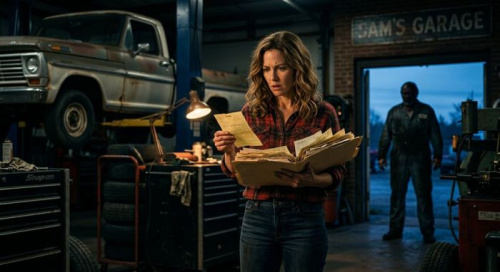
I did not run to the council. I was smarter than that, or I thought I was. I made copies of everything — forty months of invoices, the wire transfers, the dates. The dates were the thing. I lined them up against Vern's public calendar, and there it was: a payment to Bridgerock every single time Vern bought something loud. The bass boat appeared on the lake the same week a check for eleven thousand cleared. His daughter's destination wedding in the Keys — three more checks that month. I put the whole package in a manila folder and told myself I was being careful.
Careful was not enough. On the night my husband died, I was in the hospital with Frank from seven in the evening until four in the morning. He held my hand and told me I had been a good wife, and I held his and promised him the garden would survive without him. My phone was dead. My keys sat on the table at home. And yet the town hall's accounting server showed a purchase order for the bridge fund, sent from my old terminal, under my password, at one-forty-seven that morning. My password. My terminal. A signature on the approval that looked like mine if you squinted.
They found it three weeks later, during the "routine audit" Vern arranged with a firm called Whitfield & Sons. Whitfield & Sons was owned by Stan Whitfield, who played golf with Vern every Saturday and owed him his boat slip. The audit found irregularities under the treasurer's supervision. It found a pattern of payments authorized by my login. It found eighteen thousand dollars that had, according to their math, gone missing on my watch. Stan never asked me a single question. He never looked at the invoices I had copied — because by then, the folder I kept at home had already been "found" in my desk drawer at town hall, and the originals in the file room had been quietly replaced.
I tried to explain about the hospital. I had the parking stub. I had Frank's death certificate. I had a nurse who remembered my face. But a sad, grieving woman fighting to keep her pension is not news, and a beloved mayor standing in the rain saying he was "heartbroken to see a good employee make bad choices" — that was the front page. They held the vote the same week. Four to one, they let me go. The one who voted for me was a woman named Diane Whitaker, and I want you to remember her name.
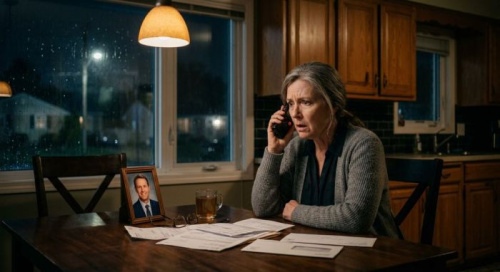
After that, Sycamore Bend turned its back on me the way it knew how — politely. The church circle stopped calling. My granddaughter Emma came home from school in tears because a boy told her her grandma was going to prison, and there was nothing I could say that was true and kind at the same time. I sent out forty job applications and got two interviews and one offer, at half my old pay, in a town forty miles away. I took it. I was sixty-one years old, and I worked the register at a hardware store because I had a mortgage and a dead husband and a folder of evidence I knew would someday matter.
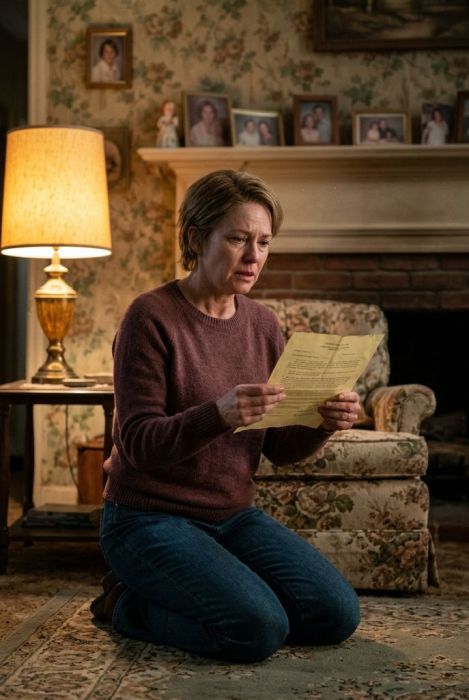
The folder sat in a shoebox in my closet for two years. I told myself that was the end of it — that justice in a small town is a quiet thing, and sometimes it never comes at all. Then a young man from the state auditor's office found my name in a stack of public records requests and drove up to the library to ask me about a company he had never heard of called Bridgerock Consulting Group. His name was Marcus Reyes. He was twenty-nine years old, and he had been chasing that company across three counties for a year — through a collapsed land deal in one town, a vanished snow-removal contract in another, and now, here, a bridge fund in Sycamore Bend.
We met at the library for four weeks, me and Marcus, reading page after page of public records at a table by the window. He showed me how Bridgerock had been created the exact week Boyd Lambert's paving company went bankrupt. I showed him my folder. When he laid the two stacks side by side, the dates matched like puzzle pieces. Marcus took it all back to Columbus, and for three months I heard nothing. I assumed that was the end of it again. I was wrong.
The call came on a Tuesday in May, the same week the council was set to vote on Vern's fourth term. He wanted to see me. Not at town hall — at his office above the bakery, the one with the big front window where everybody could see him being generous. His secretary said he wanted to "clear the air" about my pension, and that if I came in person, quietly, he might be able to help me avoid a painful local prosecution. I laughed out loud, and then I called Marcus Reyes back.
Marcus told me the state's fraud unit had been listening to Vern Ashford's voice for a month. They had a warrant for the office, the house, the boat. What they did not have was what they needed to make the charges stick: Vern's own words, in a room, saying what he had done. Ohio is a one-party consent state. If I walked into that office wearing a wire, everything he said to me was evidence. He wanted to threaten me. I just had to let him.
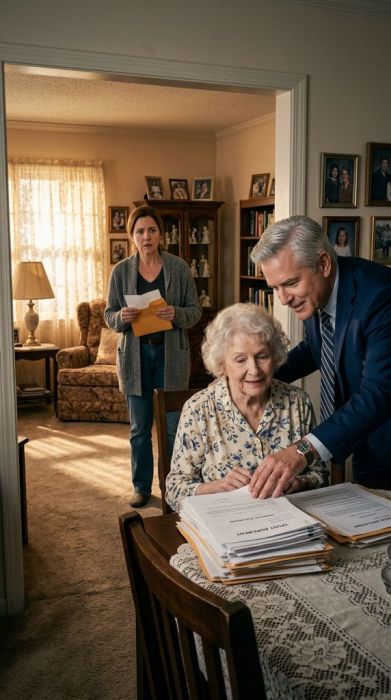
So on the last Thursday of May, I put on my best dress and walked up the stairs above the bakery. Vern met me at the top with a cup of coffee he had already poured for me, the way he had always done, and for a moment I hated how familiar it felt. He talked about the weather. He talked about Emma's birthday. Then he got to it. "Ruth, the problem isn't that money went missing. The problem is that people keep asking about it. My people — Whitfield and the rest — can make a local prosecution disappear. All you have to do is sign this paper saying you took the money and you're sorry, and I'll see you get fifteen thousand dollars and your pension."
I said, "And if I don't sign?" He leaned back in his chair and smiled the smile that had won him three elections, and he said the words I had been waiting two years to hear. "Then the county prosecutor is going to find a handwritten letter in my desk that connects you to an account in Toledo, and it's going to be an awfully hard summer for your granddaughter. I didn't get four terms by leaving loose ends, Ruth. I've buried worse people than you, and they all signed."
I signed nothing. I nodded, and I thanked him for the coffee, and I walked out past the big front window where the whole town could see me smiling, and I got into a sedan parked behind the bakery with two state investigators and a sheriff's deputy in it. The recording had been running the entire time. The agent in the front seat patted the recorder and said, "He just confessed to four felonies in under nine minutes." At four-fifteen that afternoon, they went up the stairs. I watched from the sidewalk while the town — the same town that had looked away from me for two years — stood across the street and stared at the smiling mayor being walked out in handcuffs.
It took the county prosecutor eight months to build the case. In the end, Vern Ashford pleaded guilty to theft in office, forgery, and racketeering — the racketeering charge stuck because Bridgerock Consulting Group was, as Marcus had suspected, a shell company he had used to bleed four different towns and two school districts over a decade. The judge sentenced him to nine years. His house sold at auction. His boat went to the state. Boyd Lambert, who turned on him the same morning the warrant was served, got probation for his testimony. Every family that had been cheated in the bridge fund got their money back, plus interest, from the forfeiture.
The town council did something I did not expect. It voted, six to zero, to issue a public apology to me, and to repay every penny of the legal fees I had spent defending my name. They asked me to come back as town clerk until the next election. I told them I would think about it. I thought about it for a day, and then I said yes, but only because Diane Whitaker — the woman who had voted for me when it cost her — had decided to run for mayor, and she needed somebody who knew where every dime was.
Emma asked me once, at the town pool the summer after the trial, whether I was sad about how long it took. I told her that justice is not fast, but it is patient, and it keeps a better set of books than any of us. Then I looked across the water at the covered bridge on Route 9, finally rebuilt with real money, and I thought about Frank, who always said the ledgers never lied. They never did. It was the liar who had been holding the pen all along.