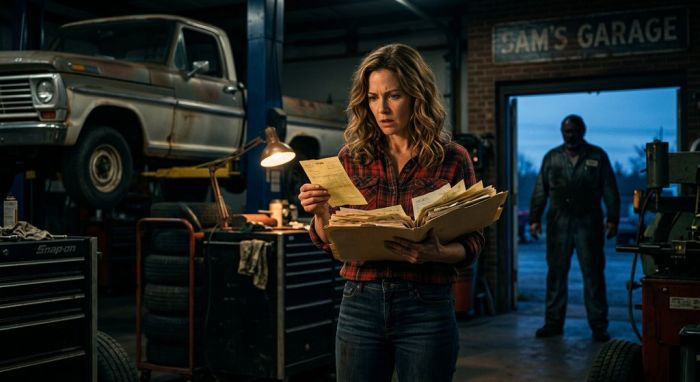
The invoice said $1,847.50 for a full brake overhaul, and it was dated three weeks after my father had his heart attack in the produce aisle of the Piggly Wiggly. The truck had been sitting in our driveway under a blue tarp the entire time. Old Blue hadn't moved an inch. And yet there it was, printed on Bannister's Garage letterhead, stamped PAID, with a neat little handwritten note at the bottom in the same looping cursive that had signed my elementary school permission slips for field trips: "Glad to help, Joe. You take care of that ticker now, you hear?"
My father, Joe Delaney, spent thirty-one years as the janitor at Chambersville Elementary. He never made much money, but he saved like a miser and he paid every bill the day it arrived. The only thing he ever splurged on was his truck, a 1998 Ford F-150 he bought the summer I was born. He called her Old Blue, and for thirty years, one man had kept her running: Ray Bannister. When my mother got sick, Ray came to the hospital with a casserole and refused to take a dime for the work he did on our car that winter. When she passed, he stood at the back of the funeral home with his cap in his hands and cried like the rest of us. Ray Bannister was not just our mechanic. He was Chambersville's mechanic. He was the man who taught the town's teenagers how to change their own oil on Saturday mornings, who sponsored the Little League team with his own money, who read the Scripture at the Easter sunrise service. Everybody loved Ray. Everybody trusted Ray.
I came home to Chambersville from Columbus because somebody had to. Daddy wasn't going to die, the doctors said, but he was going to need months of careful recovery, and the only thing worse than the idea of his heart giving out was the idea of him climbing under Old Blue with a wrench and giving it a try. So I packed up my apartment, took a leave from my job at the county records office, and moved back into the house on Maple Street where I'd grown up. The first week, I sorted the mail. The second week, I opened the shoe box.
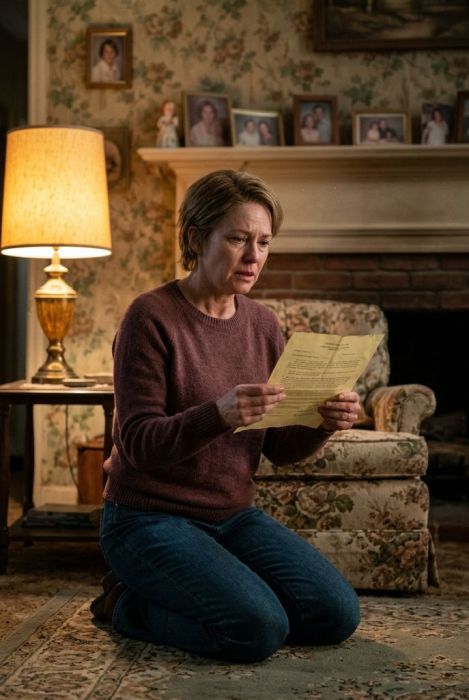
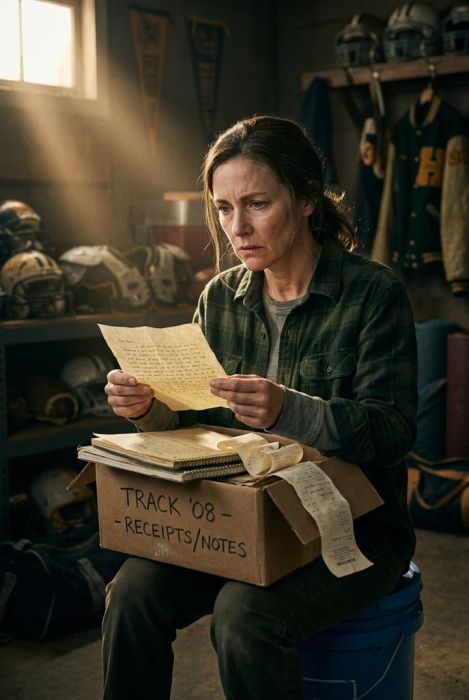
It was a plain cardboard box, the kind that once held a pair of steel-toed boots, and my father kept it in the glove box of Old Blue. Inside were every receipt for every repair on that truck since 1998. Every oil change. Every filter. Every set of tires. Every single time Ray Bannister had put his hands on that Ford, my father had a piece of paper to prove it. I only started reading them because I was cleaning out the cab, trying to get the truck ready to sell so we could pay some medical bills. Instead, I found the brake invoice. And then I found another one from April of the same year. And another from the year before that. I spread forty receipts across the kitchen table, and my blood went cold.
That is the moment I need you to understand, because it is the heart of this story. I called Ray's shop the next morning to ask about the brake job, and Ray himself answered the phone. "Clairey," he said, and he sounded genuinely delighted. "How's your daddy doing? You tell him Old Blue is sitting in my bay right now, getting her annual look-over, free of charge. I don't care what your mama taught you about charity, that truck is family." I asked him, as casually as I could manage, about the brake invoice from January. "Oh, that," he said, and I could hear the smile in his voice. "That was the job where I found the rear caliper seized up. You ask your daddy, he'll remember. I showed him the old part. He said, 'Ray, you do whatever she needs.'" I hung up and sat there for a long time, staring at the calendar on my phone. The invoice was dated January 12th. Daddy's heart attack was January 9th. My father was in the cardiac unit, sedated, with tubes in his arms, on January 12th. He hadn't authorized anything. He couldn't have.
I did what any careful, furious daughter would do. I started calling the other seniors in town. Not accusing, just asking. "Hey, Norma, while I'm sorting Dad's paperwork, did Ray happen to do any work on your Buick this winter?" Norma Hastings was seventy-four, a widow whose husband Martin had been Ray's best friend. "Oh yes, honey," she said. "He replaced my whole exhaust system. Said it was rusted through and dangerous. Cost me eleven hundred dollars." I asked if she had the old part. "He said he'd recycle it," she told me, "but the muffler still had the shine of a new one on it. I remember because I thought it was odd he called it rusted when it gleamed." I called Mr. Delgado on Cherry Street, and he'd paid for a new alternator his daughter had "personally seen him pull from the crate." His daughter shot me a text message later that night: "There was no crate. That's what I said to Dad at the time." I called eleven households that week. Every single one of them had a receipt from Bannister's Garage for work done during the exact same months Ray had billed my father. Every single one of them was over seventy. And every single one of them had been told that their repair was "an emergency" and that "Ray just wanted to look out for them."
The worst part, the part that still makes my stomach turn, is how good he was at it. Ray wasn't a slick city con man. He was the guy who showed up at your door with his own snow shovel when the plow broke down. He was the guy who fixed your lawnmower when he saw it smoking in your front yard, and refused to take cash, and then quietly billed your Medicare's supplemental insurance company for triple the labor. I found out later that he'd been doing that part for over a decade, filing insurance claims for repairs that were never made, on cars that were never brought in, for elderly customers who never saw a penny of it. The seniors trusted him because he'd earned that trust, the way such men always do, with years of small kindnesses that were probably real. And that is exactly why none of them ever questioned a single line item. That is exactly why the scam worked for so long.
Daddy got home from the rehab center in late spring, thinner but stubborn, and I didn't tell him what I'd found. Not yet. He'd spent three decades calling Ray his best friend, and I was not about to hand a man with a fresh stent in his chest that particular heartbreak until I had proof so complete he couldn't argue with it. So I kept digging. I pulled the truck's service records from the county clerk's office where I'd worked. I compared odometer stamps on the oil change stickers against the mileage on the invoices. I found a clutch rebuilt twice in the same model year, on a truck with fifty thousand miles on the clock. I found four "radiator flushes" in two years. I found a fuel pump billed in March that was already under warranty from a shop in Akron, which meant Ray billed my father for a part the manufacturer would have replaced for free. The man wasn't just stealing from my dad. He was stealing from everyone in this town who was too trusting, too polite, and too proud to ask a question.
I will tell you the exact moment I decided I was going to end him, and I'm not ashamed of it. It was the first Saturday in June, and I drove out to Chambersville Salvage, the dusty wrecking yard off Route 9, because I wanted to price a used part myself and see if the numbers matched Ray's invoices. A wiry man with a gray ponytail came out of the office trailer, chewing a toothpick, and asked if he could help me. I told him I needed a starter for a 1998 F-150. He looked at me for a long moment, and then he said, very quietly, "Your daddy's truck, right? Joe Delaney's? The one Ray Bannister takes care of?" I did not know this man from Adam. I felt the hair on my arms stand up. "Who are you?" I asked him. "Folks around here call me Walt," he said, "but if you're looking for what I think you're looking for, my real name is Sergeant Walter Okafor, and I work for the Ohio Department of Insurance, Auto Fraud Unit. I've been undercover in this yard for fourteen months."
I sat down on a stack of old tires in that salvage yard and cried, and then I laughed, and then I cried again, because I had been carrying this horrible weight all by myself, and here was a detective with a badge older than I was telling me that the State of Ohio had been quietly building a case against Ray Bannister for over a year. They'd started with a complaint from a retired school bus driver in Medina whose insurance had flagged a suspicious claim. They'd followed the paper trail. And the paper trail, it turned out, was enormous. Sergeant Okafor showed me a file folder so thick it needed two rubber bands, and in it were victims I knew — Norma's rusted exhaust system, Mr. Delgado's alternator, my father's brakes — and dozens more I'd never met. Fifty-nine victims, he said, from three counties. Over eight hundred thousand dollars, when you counted the insurance claims. And they had one problem: they could prove he'd inflated prices, but they needed the kind of overwhelming, unanswerable public proof that would make him plead out instead of trying to fight it in front of a jury of people who'd known him their whole lives.
That was where I came in. I gave Sergeant Okafor every receipt from that shoe box, and I gave him something better. I gave him my father's odometer records, which proved the truck had barely moved, and I gave him the memory of a man who had been too sick to sign anything. Then he asked me the question that changed everything: "Miss Delaney, is it true Ray throws his customer appreciation barbecue every year on the Fourth of July?" It was true. It had been true for twenty years. Ray Bannister closed the garage, fired up a pair of oil-drum grills, and fed half of Chambersville brisket and potato salad in the service bays. The mayor came. The preacher came. The whole town came. "Then that's where we take him," Sergeant Okafor said. "We do it in front of the people he robbed. We make sure there isn't a person in this county who ever looks at Ray Bannister the same way again."
The Fourth of July was six weeks away. I spent those weeks being the daughter everyone in Chambersville loved — bringing my father to church, buying tomatoes at the farm stand, sitting with Norma Hastings on her porch. And every time Ray Bannister waved at me from his tow truck, I smiled back, and I hated every muscle in my face for it. He came by the house on the first of July with a loaf of banana bread and a card signed by the whole shop, and he hugged my father like a brother. Daddy looked at me over Ray's shoulder, beaming, and mouthed the words "see? told you he was family." I smiled so hard my jaw ached. That night I called Sergeant Okafor and told him it was time. Whatever happens, I said, do it at the barbecue. I don't want to carry this lie one more day. He told me to trust him, and I did.
The morning of the fourth, Chambersville smelled like charcoal and gunpowder. I drove my father to the barbecue myself, and I helped him out of the passenger seat like he was made of glass. Ray came out of the bay in his cleanest work shirt, and he looked at my daddy with such warmth that for one terrible, ugly second I wanted to believe I'd gotten it all wrong. "Joe Delaney," he boomed, "you look ten years younger. Come on in, I saved you the folding chair by the fan." Daddy sat down next to Norma Hastings and Mr. Delgado, and I stood by the cooler with a cup of sweet tea in my hand, watching the street. The brisket was nearly gone. The mayor had made his speech. Ray was holding court near the lift, telling the story of the carburetor he'd rebuilt with nothing but a paperclip, and the crowd was laughing, and I was gripping that cup so hard my knuckles went white.
And then two unmarked Crown Victorias turned off Main Street without a single light flashing, and they rolled slow, the way cop cars roll when they're not in a hurry because they don't need to be. Sergeant Okafor got out first, and he wasn't wearing a single piece of the salvage-yard man I'd met. He was in a suit and an open collar, badge on his belt. He walked straight through the crowd, and I watched the barbecue go quiet in a widening circle around him, the way a pond goes quiet before it freezes. He reached Ray Bannister in the middle of the carburetor story and held up a warrant. "Ray," he said, loud enough for the back row, "you're under arrest for insurance fraud, theft, and taking advantage of the elderly, in fifty-nine separate counts. You have the right to remain silent." Somebody dropped a paper plate. Somebody's kid started to cry. And Ray Bannister, who had never in his life been at a loss for words, stood there with his mouth open while two more detectives turned him around and cuffed him in front of the people he'd fed for two decades. "Clairey?" he said, as they walked him past me. Just my name, like a question, like a man who genuinely could not understand how this had happened to him. I looked at him and I said nothing, and I have never once regretted that silence.
The trial wasn't a trial, because the evidence was too good. Eight hundred and twelve thousand dollars. Fifty-nine victims. Fourteen months of undercover recordings, and my father's shoe box of receipts sitting on the prosecutor's table like a monument. Ray Bannister pleaded guilty in a packed courtroom on a Tuesday in October, and he looked small, which is the best thing I can say about that day. He got nine years, which the judge read out with actual anger in her voice when she talked about Norma Hastings and her rusted exhaust system that had gleamed like new. The state seized the garage, and the garage sold, and out of that sale and the forfeiture, every single victim got their money back. Norma got her eleven hundred dollars and a handwritten apology from the county prosecutor. Mr. Delgado got his seven hundred and sixty. And my father got a check for $4,312 and a letter that called him, in official state typeface, "a victim of predatory fraud." He read it three times, and then he cried, and then he asked me how I'd known.
I told him everything. I told him about the invoice that was dated while he was in the cardiac unit. I told him about the salvage yard, and Walt, and the barbecue. He sat very still for a long time, and then he said, "I showed Ray that truck the week you were born. He knew her before I did, almost." And then my father, who had spent thirty-one years fixing other people's problems as a janitor and never once complained, did something I will remember until the day I die. He laughed. He laughed until his shoulders shook, and he said, "Well, I guess I finally got a full overhaul, too."
The honest young man who'd apprenticed under Ray, a kid named Tommy who'd quit the shop the year before because "something didn't smell like motor oil anymore," reopened the garage under the name Chambersville Auto, and he won the Little League sponsorship from the brisket ashes of the old one. He rebuilt Old Blue's brakes himself, properly, with new parts that came out of a numbered box with a manufacturer's seal, and he handed my father the keys on a Saturday morning in June. My father drove her down Main Street with the window down, waving at everybody, and when he got home he parked her in the same spot under the same tarp and went inside to make a sandwich. He's fine. I'm fine. The town is fine, mostly — a little wiser, a little sadder, a little prouder of themselves for having finally looked at the man everyone loved and asked the one question nobody had ever thought to ask: show me the paper.
I think about Ray Bannister sometimes, when I see his name on the old sign that's still faded into the brick over the garage. I think about how a man can do real good for thirty years and still talk himself into doing real harm, one small betrayal at a time, because nobody ever stopped him. And then I remember the look on his face on the Fourth of July, and I remember that the town that loved him was the same town that watched him get put in handcuffs, and I feel something that I have stopped feeling guilty about: peace. There is nothing sweeter than watching a man who thought he was untouchable discover that he was never invisible. Karma doesn't need a badge and it doesn't need a jury. Sometimes all it needs is a daughter, a shoe box, and a very patient detective with a very thick file — and a town full of people who finally decided to look.