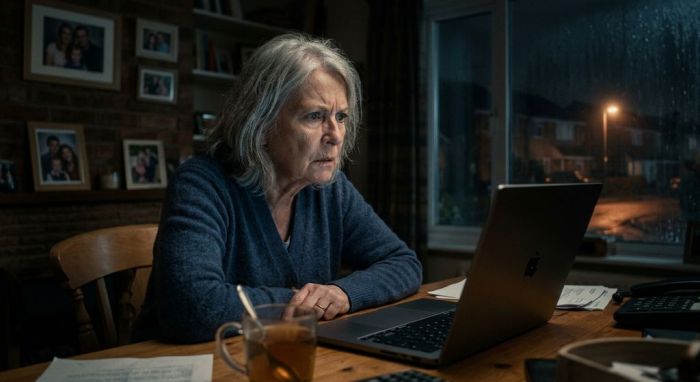
The call came in at 11:47 PM on a Tuesday.
Margaret Collins had been lying awake, staring at the ceiling, when she heard the screech of tires and a sickening thud. She knew that sound. She had taught second grade for thirty-four years, and she knew the difference between a car backfiring and something — someone — being hit.
She pulled back the curtain of her bedroom window, the one facing Birch Lane. A dark SUV was stopped in the middle of the street, its headlights illuminating a crumpled shape on the asphalt. She watched a man get out. He was tall, broad-shouldered, wearing what looked like a suit jacket. He crouched over the figure on the ground. He did not call 911. He got back in his vehicle and drove away, slowly, as if nothing had happened.
Margaret's hands trembled as she reached for her phone.
The police arrived within twelve minutes. Officer Tran was polite but skeptical. He wrote down everything Margaret said, nodding at the appropriate moments, but she could see it in his eyes. Another elderly woman. Another late-night confusion.
"We'll check the area, ma'am," he said. "But there's no sign of an accident out there."
"I saw it clear as day," Margaret insisted. "He was wearing a dark suit. The SUV — it was a black Lincoln. I think I saw a license plate starting with 7-K."
Officer Tran jotted it down. He did not look convinced.
The next morning, Margaret walked the length of Birch Lane herself. No skid marks. No broken glass. No blood. It had rained at 2 AM, washing everything clean. She stood at the spot where she had seen the body, and for a moment, she doubted herself. Had she imagined it? She was seventy-two years old. Her doctor had mentioned mild cognitive changes at her last checkup.
Then she found the button.
A small silver button, partially embedded in the mud near the curb. Expensive-looking. The kind you would see on a custom-tailored suit jacket. She picked it up and slipped it into her coat pocket.
Three days later, a letter arrived in her mailbox. No return address. The postmark was local.
Mind your own business, old woman. You don't know what you saw.
Margaret read it three times, her coffee growing cold in her hands. She called her daughter, Rachel, who lived in Portland.
"Mom, you're getting worked up over nothing," Rachel said. "Probably a prank. Kids in the neighborhood."
"Rachel, I saw a man get hit by a car. I saw the driver get out and leave him there."
"Did the police find anything?"
"No, but —"
"Then maybe you didn't see what you think you saw. You've been under a lot of stress since Dad passed. Have you been taking your blood pressure medication?"
Margaret hung up feeling smaller than she had in years. That was the worst part — not the threats, but being dismissed. The patronizing tone. The implication that she was too old, too fragile, too unreliable to trust her own eyes.
The break-in happened on a Saturday.
Margaret returned from her weekly grocery trip to find her back door splintered open. Her kitchen drawers were pulled out, papers scattered across the floor. In her bedroom, someone had rifled through her nightstand. Her jewelry box was untouched. Her television was still there. Nothing was stolen.
But the letter was gone.
The threatening letter she had hidden in her underwear drawer was missing.
She called the police. Officer Tran arrived with a partner, a heavyset man named Detective Morrison who asked questions in a flat, disinterested voice.
"Any idea who might want to scare you, Mrs. Collins?"
"I told the other officer. I witnessed a hit-and-run a week ago."
Morrison exchanged a glance with Tran. "And the victim? Did you get a name?"
"I don't know who he was. I never saw his face. But I saw the driver."
Morrison wrote it down without looking at his notebook. "We'll increase patrols in the area. In the meantime, maybe consider staying with your daughter for a few days."
It was not a suggestion. It was a dismissal.
The next week, her daughter arrived unannounced with a man in a suit.
"Mom, this is Dr. Patterson," Rachel said, her voice too bright. "He's a geriatric specialist. I thought he could do a little evaluation, just to make sure everything is okay."
Everything was not okay. Margaret understood immediately. Her daughter was gathering evidence to declare her incompetent. The break-in, the letters, the hit-and-run — it was all being framed as the fantasies of a failing mind.
Dr. Patterson asked her questions. What year is it? Who is the president? Can you subtract seven from one hundred? Margaret answered every question correctly, but she could feel the trap closing. If she protested too loudly, she would seem paranoid. If she remained calm, they would say she was in denial. There was no way to win.
After the doctor left, Rachel sat her down at the kitchen table.
"Mom, I'm worried about you. These stories about hit-and-runs and letters — it sounds like you're having episodes. I found a lovely assisted living facility in Salem. Just until you're feeling better."
"Rachel, I am not losing my mind."
"Then prove it. Show me something — anything — that proves what you're saying is real."
Margaret pulled the silver button from her coat pocket. She had been carrying it everywhere, a secret talisman. She placed it on the table.
"I found this at the scene. It's from the driver's suit jacket."
Rachel picked it up, turned it over in her fingers. Her expression softened for just a moment. Then she shook her head.
"Mom, this could be from anywhere. It doesn't prove —"
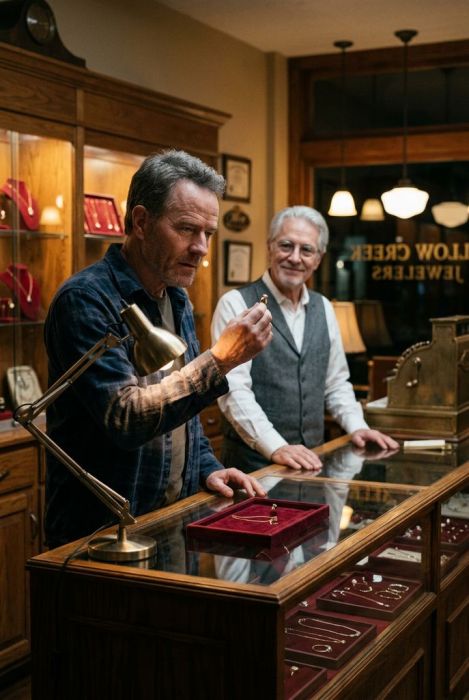
"Take it to a tailor. Ask them what kind of suit uses buttons like this. It's custom. It's expensive. There cannot be many in this town."
Rachel sighed and pocketed the button. She promised nothing.
Margaret did not go to assisted living. Instead, she did something that surprised everyone, including herself.
She remembered the nanny cam.
Two years ago, after a spate of package thefts on Birch Lane, her son-in-law had installed a small camera above her front door. It faced the street. She had forgotten about it entirely. The footage was stored on a memory card in the living room closet.
She pulled the card, inserted it into her old laptop, and began scrolling through days of footage.
There it was.
November 14th. 11:47 PM. The grainy night-vision footage showed a black Lincoln Navigator slowing down. A figure crossing the street. The impact. The body falling. The driver getting out, crouching, getting back in. Driving away.
The license plate was clearly visible: 7-K-R-9-4-2-1.
Margaret's hands were shaking, but this time not from fear. From fury.
She called Officer Tran. This time, she sent him the video file. He called back within thirty minutes. His voice had changed completely.
"Mrs. Collins, I need you to make a copy of that file and not share it with anyone. Do you understand?"
"I understand."
"And Mrs. Collins? I'm sorry. I should have listened to you from the beginning."
The license plate was registered to a man named Harold Vance, the owner of Vance Development, a construction company that had won nearly every municipal contract in the county for the past decade. He was fifty-eight years old. Married. Two children. A regular at the Birch Lane Country Club. A man who smiled for the cameras at charity galas and ribbon-cutting ceremonies.
The victim was a homeless man named Leonard Cross, fifty-six, who had been living in a tent behind the abandoned gas station on Maple Avenue. No family. No one to report him missing. The medical examiner confirmed that Leonard's injuries were consistent with being struck by a vehicle. He had a fractured skull, a broken pelvis, and internal bleeding. He had died at the scene.
When the police showed Harold Vance the footage, he said nothing. His lawyer arrived within the hour.
"I want to see the original footage," the lawyer demanded. "This could be doctored. My client is a respected businessman. He's being targeted by a confused elderly woman with a grudge."
But the footage was not doctored. An FBI forensic analyst confirmed its authenticity. The time stamp could not be altered. The angle matched Margaret's front door. And the button she had found — a rare Italian-made mother-of-pearl button, sold exclusively by a tailor in Seattle who had kept meticulous records of every custom suit he had made in the past fifteen years — matched Harold Vance's wardrobe exactly. The tailor testified that he had personally sewn those buttons onto three suits for Mr. Vance. One of those suits, the tailor noted, had been picked up by Vance just three days before the accident.
The trial lasted six weeks.
Margaret sat in the front row of the courtroom every single day. She watched as Harold Vance's lawyers tried to paint her as unreliable, as a lonely widow desperate for attention, as a woman whose mind was slipping. They brought in Dr. Patterson, who testified that Margaret had shown signs of possible early-stage dementia. They brought in a former neighbor who said Margaret had become forgetful in recent years. They brought in a handwriting expert who claimed the threatening letter could have been written by Margaret herself.
Then the prosecution played the footage.
The courtroom was silent as the grainy video showed Harold Vance, a man in an expensive suit, crouching over a dying man, standing up, and driving away. There was no sound, but none was needed. The image of a man walking away from a dying person while adjusting his cuff links spoke louder than any testimony.
The prosecutor, a young woman named Elena Reyes, turned to the jury.
"The defendant had a choice. He could have called 911. He could have gotten help. Instead, he left a man to die on a cold street, then spent the next three months trying to destroy the only witness — a seventy-two-year-old woman who had the courage to do what he would not. He threatened her. He broke into her home. He tried to have her declared incompetent. And he did all of this while wearing a three-thousand-dollar suit and a smile."
The jury deliberated for four hours.
Harold Vance was found guilty of leaving the scene of an accident resulting in death, witness intimidation, and burglary. He was sentenced to twelve years in state prison. The judge, a stern-faced woman named Patterson (no relation to the doctor), looked directly at Vance as she read the sentence.
"You believed your money and your status would protect you. You believed a seventy-two-year-old woman could be silenced and dismissed. You were wrong on both counts."
After the verdict, Margaret's daughter Rachel approached her in the hallway. She was crying so hard she could barely speak.
"Mom, I'm so sorry. I should have believed you. I should have trusted you."
Margaret looked at her daughter — really looked at her — and for a moment, she felt the weight of everything. The loneliness. The fear. The humiliation of being treated like a child in her own home.
"Yes," she said quietly. "You should have."
She turned and walked out of the courthouse into the cold Oregon sunlight, the silver button still warm in her pocket. She had kept it, not as a trophy, but as a reminder. She was not confused. She was not forgetful. She was not someone to be dismissed.
And somewhere in a prison cell in Salem, Harold Vance was learning the same lesson.