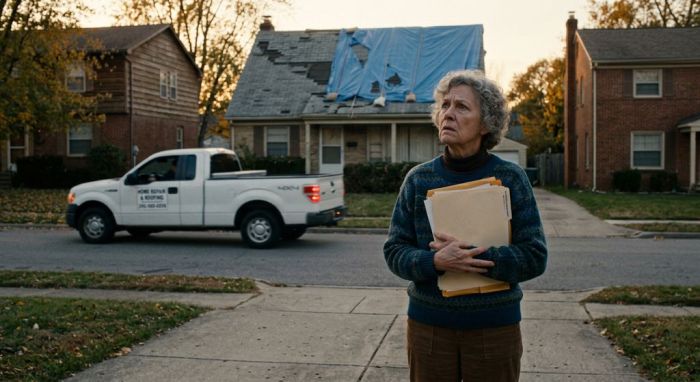
The day the hail finally stopped, I counted seven new dents in my car and found a fist-sized hole where my roof used to be. I was still standing on the gravel, holding a shingle that had blown all the way into my rose bushes, when the white truck pulled into my driveway. It was glossy and brand new, with a magnetic sign on the door: Covington Restoration, Free Storm Inspections.
The man who stepped out had the kind of warm, practiced smile you see on men selling used cars or ministering at televised revivals. He introduced himself as Ray Covington, and he told me he'd been in the neighborhood all week helping folks after the storm. He pointed at my roof with genuine concern. "Ma'am, that's not going to hold through the next rain. I can have a crew up there by Friday."
My husband, Bill, had been gone three years. We'd bought this little house in Cedar Hollow, Oklahoma, back in 1988, and Bill had kept the roof sound until the day he got sick. I didn't know a shingle from a truss. Standing there in the drizzle, tired and alone, with a stranger's kind eyes studying my damage, I let my guard down exactly the way every scammer hopes an elderly widow will.
He wrote out an estimate on a clipboard, all neat and professional. Six thousand four hundred dollars, with two thousand down for materials. He held out his hand. "I'll take care of everything, Mrs. Calloway. You don't worry about a thing."
That night, I signed the agreement and wrote the check, and I told myself I was lucky that someone so reliable had knocked on my door when I needed him most.
For the first week, Ray Covington was everywhere. I watched him from my kitchen window as his crew tore up shingles and dropped new bundles onto my roof. He brought me coffee in the mornings and asked about Bill, about my garden, about my son who lived two states away. He had a way of making you feel heard. When the neighbors' kids rode by, he'd wave and toss them a handful of candy from his cab.
All up and down Cedar Hollow Road, the same thing was happening. Mrs. Alvarez on the corner had a collapsed carport. The Whitfields had lost half their siding. Old Vernon Thompson, who'd lived next door since before Bill and I married, had a tree punch a hole straight through his kitchen. Ray Covington seemed to be on every driveway, clipboard in hand, promise on his lips, collecting two-thousand-dollar deposits like it was the most natural thing in the world.
The second week is when I started to notice the small things. The crew he'd bragged about never grew beyond two men, and they were the same two men every time, driving the same old pickup with the duct-taped tailgate. The shiny white truck with the magnetic sign belonged to Ray alone. And for all his smooth talk about permits and inspections, I never once saw the county truck roll down our road.
I called the number he'd left me, just to ask about the permit. It rang twice, then went to a recording. "You've reached Covington Restoration. We're out on a job right now. Leave a message." I left one. He called back the next day, full of apologies, and told me the county was backed up for weeks because of the storm. It sounded reasonable. I believed him.
The hail came again on the fourteenth night, and this time it took three shingles right off the patch of roof his crew had supposedly fixed. I stood in my robe at midnight, rain dripping through my ceiling into a soup pot, and I finally let myself feel the cold knot of doubt that had been forming in my stomach for days.
I did something that weekend that probably saved me from losing everything. I drove down to the county clerk's office, and I asked a very quiet, very patient woman named Nancy to pull up Covington Restoration's business license. She turned her computer screen toward me with a look I'll never forget. "Ma'am," she said, "there is no Covington Restoration on file. There never has been."
That's when I understood, with a clarity that made my knees weak, that Ray Covington was not a repairman at all. He was a storm chaser — the kind of predator who boards up behind a disaster. And I had handed him two thousand dollars and a signature that might as well have been a blank check.
I should have gone to the sheriff right then. Instead, I drove home and started digging. I made a list of every name on my street that Ray had shaken hands with. Then I turned to the town's little Facebook group, the one where people posted about lost dogs and church bake sales. I typed a single, careful post: "Did anyone on Cedar Hollow or the surrounding roads hire Covington Restoration after the storm? Please message me privately."
Within three days, I had twenty-two names. Restaurants, roofs, driveways, fences, a water heater Ray had promised to replace and never did. And the amounts formed a sickening pattern — every single one of them had listed Ray Covington Restoration as the payee, and every single one had handed him a deposit. Roughly forty-one thousand dollars, gone, in a town of four thousand people.
Nancy from the county clerk's office called me back with something even colder. Ray Covington did not exist on any business registry in the state. But the county had a record in its own system from six years earlier — an arrest in Bartlesville for petty theft, under a name that was only one letter off from a man who'd been a known contractor in Arkansas. The man I'd welcomed into my home went by at least three different names, but his signature, across all those victims' contracts, was identical.
The more I learned, the bolder he got. And that frightened me, because somewhere inside his arrogance I saw my chance. Ray came back to town two weeks after the flooding stopped, acting as if he'd simply been busy. He didn't knock on my door; he parked his white truck at the diner downtown and bought breakfast for half the room, telling everyone he had big plans, a whole new contract on the east side of the county, that he'd be hiring local men within the month. The town, hungry for work and weary of storms, practically cheered him.
I watched him hold court from a booth near the window, the once-fearful resentment curdling into something colder in my chest. Ray Covington had collected forty-one thousand dollars from people who trusted him, and now he was back to take more. The only way to stop him, I realized, was to let his greed do the heavy lifting.
That was when I drove to the sheriff's department and asked for Detective Sergeant Marcus Hale by name. Marcus had known Bill back in high school. He didn't laugh at me. He sat me down, pulled out a legal pad, and listened for over an hour while I laid out my spreadsheet, the county records, Nancy's findings, and the identical signature across every stolen contract. When I finished, he leaned back and tapped his pen against the pad. "You've done a deputy's job, Carol. But I'll tell you what I need to make this stick: I need him to take money from somebody, on the record, after you've told me he's under investigation. I need the act itself."
So we set the trap, and it was simpler than any of the crime shows Bill used to watch. Marcus had me open an account in the name of a friend of mine, Doris Kramer, whose porch had a leak she'd been meaning to fix. He wrote out a script for me to follow. And I made the phone call that would end Ray Covington's reign in Cedar Hollow forever.
I told him Doris had caught another storm's worth of damage at her place and had cash in hand, but she only wanted to deal with the man himself, the one everyone on the street trusted. I could hear the greed in his voice, the smile in his words, as he agreed to come by her address that Saturday morning. When I hung up, my hands were shaking, because I knew exactly who would be waiting for him there.
Saturday came gray and damp, the kind of morning that smells like more rain. I parked two doors down from Doris's house and watched from my car, my hands wrapped around a cold mug of coffee I never drank. Ray rolled up right on time in his white truck, climbed out, and straightened his jacket. He knocked on Doris's door with the same warm smile he'd given me two months earlier. Doris opened it, all flustered and grateful, and invited him inside with her porch money waiting on the table.
Then a second car pulled into the driveway. Marcus and his deputy got out, and Ray turned to see them. His face did something remarkable in that one frozen moment — the charm drained out of it entirely, replaced by the hard, cornered look of a man who finally understood that his luck had run dry. Marcus read him his rights right there on Doris's porch, in front of the neighbors who'd gathered at their windows to watch.
I walked over as they cuffed him, and I saw the papers I'd spread across Doris's kitchen table — the contracts, the receipts, the county records, the identical signatures from four different storm-battered towns. Marcus held up one of them. "Mr. Covington, or whatever your name really is, we've got forty-one thousand dollars in documented deposits just on this one street, and we've got a trail that leads to three other counties. You're not going anywhere for a long time."
He looked at me then, and I saw something I hadn't expected: not anger, but genuine, baffled disbelief. He had charmed widows in five states, collected close to a quarter of a million dollars over twelve years, and he'd been undone by a sixty-four-year-old woman with a folder of paperwork and a helpful clerk at the county office. It was the last time I ever saw him.
The trial lasted longer than I expected, but the evidence was airtight. Marcus and the county prosecutor laid it all out — the fake licenses, the laundered deposits, the legitimate contractor in another state whose registration Ray had been quietly trading on for years. The jury took less than a day to convict him on twenty-three counts of fraud and larceny. The judge, a stern woman from Tulsa who'd heard too many of these cases, sentenced him to nine years in state custody and ordered full restitution.
And here's the part that still brings me to tears when I think about it. Because Ray had been bonded, the court was able to claw back a surprising amount of the money. The check I received five months later for my two-thousand-dollar deposit wasn't the main thing. The main thing was that Mrs. Alvarez got her carport fixed, the Whitfields got their siding, and old Vernon Thompson finally had a smooth, dry kitchen ceiling for the first time since the tree came through.
The town of Cedar Hollow forgave me, I think, for being the one who'd first waved Ray Covington up our road with such grateful eyes. Because in the end, that trust became the very trap that caught him. Marcus still calls me every spring, around the time the storm season starts, just to check in. He says I'm the sharpest witness he's ever worked with. I tell him I'm just a widow who learned that the people who knock on your door after disaster strikes are either angels or wolves — and that the wolves always get sloppy when they think they've won.
Bill's little house still has the patch of shingles Ray's crew never finished, and I put a fresh coat of sealant on it myself this year. It's not perfect. But these days, I sleep dry, my savings are intact, and when a stranger's truck tries to pull into my driveway now, I stand on my porch with my folder of paperwork already in hand and a very long memory.