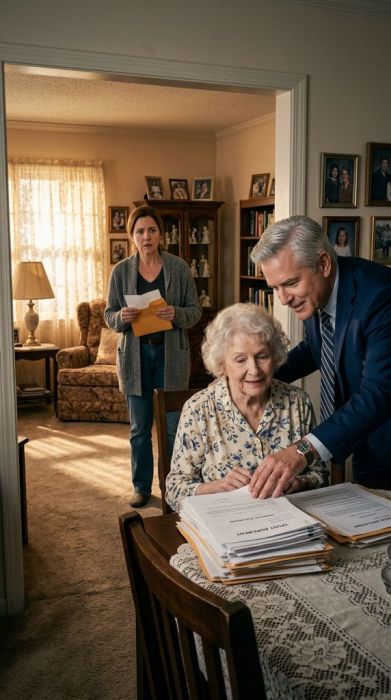
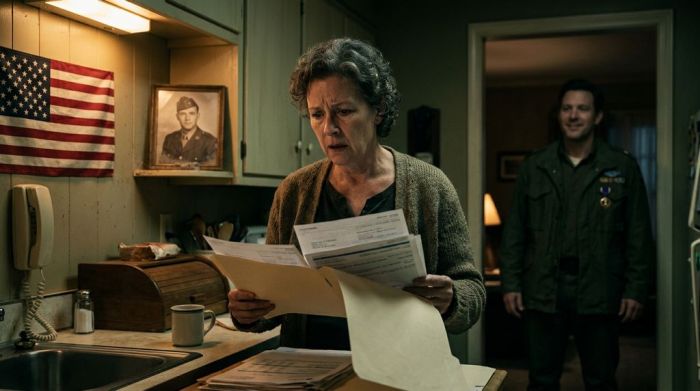
The day I found out Dale Whitfield had never worn a uniform, I was standing in my own kitchen holding a checkbook and feeling like the floor had dropped out from under me. Outside, the sun was setting over our little street in Cedar Falls, Iowa, the same street where my husband Frank and I had raised two kids and planted a garden he never got to see bloom. Dale had been at my house an hour earlier, sitting at this very table laying out plans for the biggest fundraiser our town had ever seen. He had shaken my hand and called me a hero's widow, and I had believed every word of it.
Frank served two tours in Afghanistan and came home to me with a limp, a Purple Heart, and a quiet sadness he never quite put into words. He died of a heart attack three years ago, and the flag they handed me at his funeral still sits folded in a box in my closet. When Dale Whitfield walked into the VFW hall six months ago wearing that same medal and talking about my husband like they were brothers, I did not think twice. I saw a man who understood my grief. I did not see the thief standing in front of me.
This is a story about how a con artist took my town for everything it had, and how I ended up on a stage in a rented ballroom watching the police walk him out in handcuffs. It is long and it is ugly, but I promise the ending is worth it.
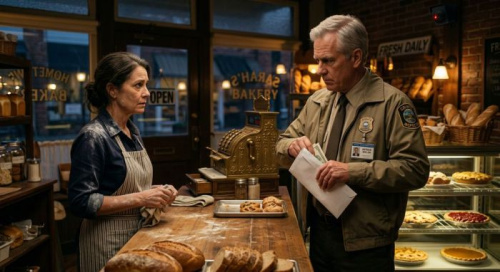
Dale Whitfield arrived in Cedar Falls the way most wolves arrive in a small town: covered in sheep's clothing and carrying a story. He showed up at the VFW one Tuesday evening in late February, a stout man in his forties with a booming voice and a handshake that could crush a soda can. He wore a faded camo jacket with a flag patch and a Purple Heart pinned over his heart, and he told anyone who would listen that he had moved here from Ohio to be closer to his late brother's family.
The first person he charmed was my neighbor Sandra, who had lost her own son to an IED in 2009. Dale sat with her for an hour that first night, holding her hand and telling her about the day he carried a wounded buddy out of a firefight. Sandra cried. So did half the room. By the time he stood up to leave, he had her phone number, mine, and the number of the VFW post commander, a retired sergeant named Don Marsh.
I will give Dale this much: he was very good. He never once said the words "I served with your Frank," not in so many words. He would simply tilt his head, let his eyes go soft, and say something like, "Your Frank, he was a hell of a soldier. We lost too many good ones." And everyone filled in the blanks themselves. That is the con, you see. He never had to lie outright. He just let us believe the lie for him.
Within a month, Dale had a key to the VFW hall and a seat on the auxiliary board. He pitched an idea that made every veteran lean forward: a charity called Operation Guardrail, a nonprofit to raise money for struggling vets with medical bills, burials, and what he called "the lonely ones nobody visits." He had paperwork printed on thick paper with a gold seal, a website that looked like it cost ten thousand dollars, and framed testimonials from veterans in three states.
And he had me. I was the widow, the face he put on every flyer. I stood at the bake sale table and told people Operation Guardrail would make sure no veteran in Cedar Falls died alone. I believed it because I wanted to believe it. Because believing it made me feel like I was carrying Frank's torch instead of just his memory.
The money came in faster than any of us expected. A charity motorcycle run raised eleven thousand dollars. A spaghetti dinner at the firehouse raised four. We put collection jars at the diner and the hardware store, and every week they were full. Dale kept a ledger, a beautiful leather-bound book, and every donation went into it in his careful handwriting. He showed it to us at every meeting, smiling and patting it like a beloved pet.
I did not know, until much later, that the ledger he showed us was not the only one.
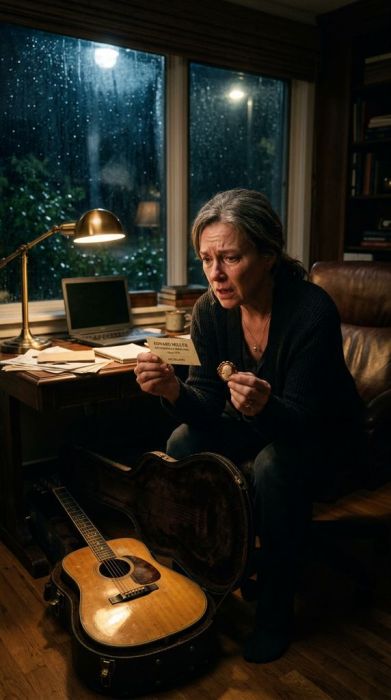
The first crack came in June, at a car show on the old fairgrounds. A woman I did not recognize pressed a folded piece of paper into my hand and walked away without a word. I opened it that night in my kitchen. It was a bank statement from a Chase account in Toledo, Ohio, in the name of Dale R. Whitfield, showing fifty-two thousand dollars in deposits over the previous eleven months.
I stared at that paper for a long time. Maybe Dale had a savings account. Maybe he had money from selling his house. It was none of my business what a good man did with his own money.
But something felt wrong. So I did what any suspicious small-town widow would do: I kept the paper, and I started paying attention.
Over the next few weeks I watched Dale like a hawk, and the more I watched, the more I saw things I had been too trusting to notice. He handled all the cash himself, never letting anyone else count it. He was always the one to make the bank runs, and he came back with a smile and a receipt, but never with the deposit slip. And Sandra, his biggest supporter, had started going quiet at meetings, refusing to meet his eye.
One night I asked her about it over coffee. She looked at me for a long time, then pulled out a crumpled receipt for a wire transfer she had made to Operation Guardrail, five hundred dollars saved from her late son's disability settlement. "I asked him for a copy of the 501(c)(3) letter," she said quietly. "He said he would bring it to the next meeting. He has not brought it."
I told myself there was probably an explanation. I told myself, for the hundredth time, that Dale was a good man.
Then, three weeks later, I found out I was wrong.
It was a hot July afternoon and I was helping Dale sort a box of donated items at the VFW hall when he excused himself to take a phone call. He stepped into the supply closet and left the door cracked, and because the ceiling fan was loud, he must not have realized how much of his conversation carried. I heard him say, "No, I am not going back to Ohio. We are pulling in more here than we did in Toledo. You have a problem with that, you call my lawyer."
I stood frozen with a donated flag in my hands. Toledo. The bank statement in my kitchen drawer was for an account in Toledo. And suddenly I understood I had not been watching a good man with a savings account. I had been watching a man who had done this before.
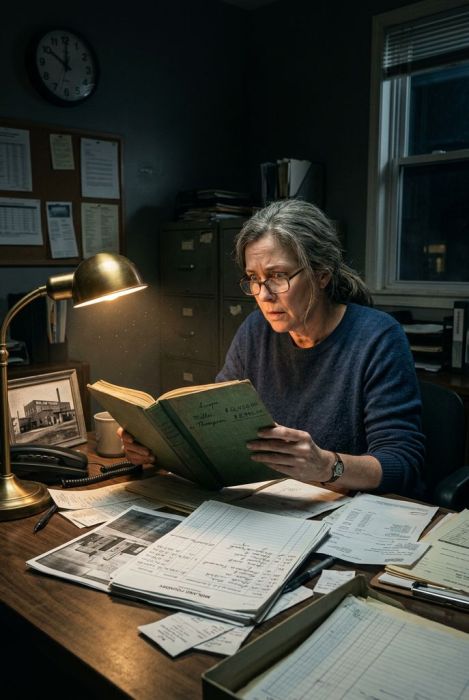
That night I did not sleep. I sat at my kitchen table and made a list of every strange thing I had seen since February. And when I was done, I drove to the one person in Cedar Falls I trusted more than anyone: Don Marsh, the VFW post commander who had never once let the town down.
Don listened to everything, his weathered face going stonier with each word. When I finished, he called a man named Ray Halsey, an old Army buddy who did background checks for a security firm in Des Moines. "Ray," Don said, "I need you to run a name for me. Dale Whitfield. I need his record. And Ray," he added, his voice going hard, "I need you to tell me if he was ever military at all."
We heard back in four days. Dale Whitfield had never served a single day in the military. There was no DD-214, no service record, no Purple Heart, no brother who died in combat. There was, however, a criminal file in Ohio and one in Pennsylvania for charity fraud, both involving fake veterans' funds. He had been doing this for almost fifteen years, changing states every time the trail got warm, and Cedar Falls was just his latest stop.
I was angry and relieved and ashamed all at once. Angry at Dale for what he had taken. Relieved that I had not gone crazy. Ashamed that I had been so ready to believe a handsome man with a medal and a sad story. And beneath all of it, a cold, quiet certainty: I was going to end him.
But Don and I knew we could not just walk into the VFW and accuse him. Dale had the town in his pocket, and if he talked his way out of it, we would look like jealous fools and he would be gone by morning with every dollar.
So we did it the way you catch a con artist: we let him believe he had won, and then we closed the trap when he was least expecting it.
The plan came together over the next month. Don reached out to the Cedar Falls County Sheriff's Office, where a fraud detective named Elena Ruiz had been tracking donation scams across the state. She connected us with a genuine combat veteran named Marcus Webb, a wiry, kind-eyed man who had served in the same unit as my Frank. When Marcus learned what Dale was doing, wearing a medal he never earned and taking money meant for men like him, he sat down with us and helped plan the whole thing.
The centerpiece of our plan was the gala. Dale had been pushing for a big, expensive fundraiser for weeks, a black-tie event with a catered dinner and a silent auction, all of it presumably to raise money for the veterans' fund. We could not have asked for more.
So we let him have it. We booked the ballroom at the Cedar Falls Country Club, printed tickets, and sold them for a hundred dollars apiece. We let Dale plan every detail, smiling and nodding, while behind his back Don was on the phone with Sheriff's detectives and Marcus was quietly gathering every elderly veteran who had been promised housing or medical help that never came.
The night of the gala, the ballroom was packed. There was a big banner that read OPERATION GUARDRAIL — HONORING THOSE WHO SERVED, a stage with a podium and a microphone, and in the corner, Dale Whitfield in a brand-new tuxedo, working the room like a politician as if he had just won a war himself.
When dinner was done, Dale took the stage and started to talk about sacrifice and service. He was good. God, he was so good. He told a story about a soldier named Tommy who had died in his arms, and half the room was crying, and I watched him milk it, watched him wait for the exact right moment to ask for more donations.
And that is when I walked to the stage.
The room went silent in a way I have never heard a room go silent. Dale turned, surprised but still smiling, and held out his hand like he was welcoming an ally. "Here she is," he said warmly, "the heart of Operation Guardrail. Frank's widow. Please, come up here."
I climbed onto the stage, set my manila folder down on the podium, and looked at the two hundred faces staring up at me. Then I looked at Dale. "Tell everyone here your unit," I said, loudly enough for the microphone to catch.
He blinked. "My— my unit?"
"Yes. Your military unit. The one you served with."
Dale laughed, a little too loud, a little too nervous. "Well, I was with the 82nd Airborne—"
"No you were not." I pulled the first page out of my folder and held it up so the room could see it, the background check that said, in black and white, that Dale R. Whitfield had no military record at all. "There is no 82nd Airborne service record under your name. There never was. You were never in the military, Dale. You were never even close."
The murmur turned into a roar. People stood up. And in the back of the ballroom, the double doors swung open and Detective Elena Ruiz walked in with two deputies, and behind her, in full dress uniform, came Marcus Webb, the real veteran who had actually served with my Frank.
Dale's face went white. He made a grab for the podium, for the folder, for anything, but Don Marsh was already there, sixty-nine years old and fast enough to cut him off. By the time the deputies reached the stage, Dale was standing with his hands raised and his tuxedo ruined with sweat.
"It's a mistake," he kept saying. "I built this charity. I built it with my own money."
"You built it with my town's money," I said, and I held up the bank statement from Toledo and the copies of the receipts Sandra and a dozen other people had given us. "And you are going to pay for every single cent of it. Every dollar you took from grieving widows and old soldiers who trusted you."
They led him out in handcuffs, past the banner that still read HONORING THOSE WHO SERVED, past the silent, staring faces of the neighbors he had conned. It is a strange thing, the moment you realize the person you trusted was never who they said they were.
The aftermath was not a fairy tale. Most of the donations were recovered once the Sheriff's office froze Dale's accounts, but some was already gone. Sandra got her five hundred dollars back, and I was glad, but money was never really the point. A man had walked into our town wearing a dead soldier's honor and used it to line his own pockets, and we had stopped him.
Dale Whitfield pled guilty to charity fraud and to impersonating a military veteran, a federal offense. He is currently serving six years in federal prison. His name is not on the DD-214 of any soldier anywhere, and it never will be.
As for Operation Guardrail, we did not let it die. We changed its name to the Cedar Falls Veterans Fund, gave it a real board, a real 501(c)(3), and turned it over to Marcus Webb, the man who had actually served. The first thing Marcus did was pay for the burial of a homeless vet nobody else would claim. The second thing he did was hand me a check for the money that had been stolen, and I put it in a savings account for my granddaughter.
A few weeks ago I stood in my kitchen again and looked up at the folded flag on my shelf and at Frank's photo beside it. And I felt, for the first time in years, at peace. Not because I had won, though I had. Not because Dale was in prison, though he was. But because I had finally done right by Frank, right by the town, and right by every real veteran who had ever worn that uniform with honor.
They say a con artist only takes what you are willing to believe. Maybe that is true. But they only get away with it until someone decides to look closer. I looked closer. And in the end, the only medal Dale Whitfield ever earned was the one the prison issued him when they took his picture for the booking file. The whole town thought they were honoring a hero. But the only real heroes in that room were the ones who had actually served. And they watched him leave in handcuffs.