The first time I noticed something wrong, I told myself I was being paranoid. My mother had dementia. Things get misplaced. Memories fade. That's the nature of the disease.
But when I walked into her bedroom on a Tuesday afternoon and found her sitting on the edge of the bed, staring at her own hands like she didn't recognize them, a cold feeling settled in my chest that I couldn't shake.
"Mom?" I said softly. "Are you okay?"
She looked up at me, and for one terrible second, there was nothing in her eyes. No recognition. No warmth. Just the hollow gaze of a woman who had been hollowed out from the inside.
Then she smiled, and my mother was back. "Oh, honey. I was just resting my eyes."
I told myself it was the dementia progressing. Dr. Patel had warned us this would happen. But something in my gut whispered: Look closer.
Her name was Diane Fletcher, and she had the most reassuring references I had ever seen. Three letters of recommendation. Seven years of experience. A certification in geriatric care from a respected college in Ohio. When I interviewed her in the living room of my mother's home in Columbus, she held my mother's hand with such tenderness that I almost cried with relief.
"I treat every client like they're my own family," she said, and her eyes glistened with sincerity. "Your mother will be in excellent hands."
My sister Karen, who lived in Seattle, did a video call with Diane and approved immediately. "She's perfect, Mark. We're lucky to have found her."
I paid Diane fifteen dollars an hour under the table. Cash. She said it helped with her taxes. I agreed without question because she was so warm, so competent, and my mother — sweet, confused Eleanor — had started calling her "the nice lady" within three days.
The first month was a blessing. Diane cooked my mother's favorite meals — meatloaf on Tuesdays, chicken and dumplings on Fridays. She kept the house spotless. She even drove my mother to her doctor's appointments and reported back with detailed notes. I felt like I had hired an angel sent directly from heaven.
"The dementia is progressing," Diane told me one evening, her face full of practiced sympathy. "She had a rough day today. Didn't recognize me for about two hours."
My heart sank. "Is she getting worse?"
"It's natural," Diane said, squeezing my arm. "But I'm here. I'll take care of her."
I believed her. I believed every single word.
The first red flag was the bank statement.
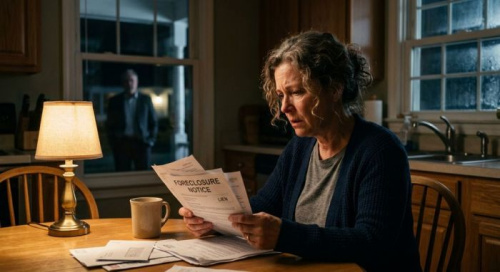
I had always managed my mother's finances. Social Security deposited directly into her checking account. Automatic withdrawals for Medicare and the reverse mortgage insurance. I checked the account every month like clockwork, never expecting to find anything unusual.
In the third month, I noticed a withdrawal I didn't recognize. Two hundred dollars. Cash. ATM withdrawal at a branch downtown.
"Mom, did you take money out of your account?" I asked gently.
She looked at me with confusion swimming in her eyes. "I don't go to the bank, honey. Diane drives me everywhere."
My stomach tightened. "Diane took you to the bank?"
"Last week, I think. Or maybe it was Tuesday." My mother's eyes drifted away. "She's so helpful, Mark."
I called Diane that evening. "Hey, I noticed a cash withdrawal from my mom's account. Did you drive her to the bank?"
"Oh, yes," Diane said smoothly. "She wanted to buy you a birthday present. She was embarrassed to ask you to take her. I hope that was okay."
The lie was so warm, so thoughtful, that I almost let it go. Almost.
"Next time, just let me know," I said. "I want to make sure everything's documented."
"Of course," she said. "I'm sorry, Mark. I was just trying to help."
I let it go. That is what haunts me most. I let it go.
The second red flag was physical.
My mother had always been a proud woman — makeup on her face, hair perfectly set, dressed in her favorite floral blouses even when she had nowhere to go. But in the fourth month, I noticed changes. She stopped wearing makeup. Her hair was unwashed. She wore the same faded housedress three days in a row.
"Mom, are you feeling okay?" I asked.
"I'm tired, honey. Diane says I should rest."
I found empty bottles of wine in the recycling bin. My mother didn't drink. Not a single glass since my father passed away ten years ago.
"Diane likes a glass sometimes," my mother said vaguely when I asked. "She says it helps her sleep."
The third red flag was the bruise.
A purple-green mark on my mother's upper arm, the exact size and shape of a thumbprint.
I felt my blood turn cold. "Mom, what happened?"
"I don't remember." She pulled her arm away, wincing. "I'm so clumsy these days."
I confronted Diane in the kitchen. "There's a bruise on my mother's arm. A handprint."
Diane's face crumpled into hurt. "Mark, I would never hurt your mother. She fell last night when I was helping her to the bathroom. I caught her, but I must have gripped too hard. I am so, so sorry."
Tears streamed down her face. She looked devastated, heartbroken, consumed by guilt. I wanted to believe her. I needed to believe her. Because if Diane was lying, then I had left my mother with a monster.
I bought the camera that night. A small nanny cam disguised as a smoke detector. It was delivered the next morning.
I told Diane I had a business trip to Cleveland. "I'll be gone two days. Can you handle things?"
"Of course," she said warmly. "Your mother and I will be just fine."
I parked my car at a friend's house three blocks away. I walked back through the neighbor's backyard and let myself in through the basement entrance — the one Diane didn't know existed.
I set up the camera in my mother's bedroom. I tested it three times. Then I went back to my friend's house and watched the live feed on my phone.
The first hour was normal. Diane brought my mother lunch — a can of soup, not the homemade meals she had promised. My mother ate quietly. Diane sat in the corner scrolling through her phone, ignoring her.
Then my mother asked to use the bathroom, and I watched Diane grab her arm. Hard.
"Not now, Eleanor. I'm busy."
"But I really need to—"
"I said not now." Diane's voice was ice. "You can wait."
My mother looked down, ashamed. "I'm sorry, Diane."
I watched for another two hours. What I saw destroyed me.
Diane screamed at my mother for spilling water. She took my mother's phone when my aunt called. She opened the mail and pocketed a fifty-dollar bill my aunt had sent. She poured herself a glass of wine and watched television while my mother sat in soiled clothes because Diane hadn't helped her walk to the bathroom in time.
And then, at seven o'clock, I watched Diane sit on the edge of my mother's bed and say, "Eleanor, I need you to sign this paper. It's for the insurance company."
My mother squinted at the paper. "What is it, dear?"
"Nothing important. Just a form. Sign here."
My mother's hand shook as she held the pen. "Mark usually handles these things."
"Mark is very busy," Diane said, her voice hardening like steel. "Sign the paper, Eleanor."
My mother signed.
I was at the Columbus Police Department within the hour.
The detective who took my statement was a fifty-two-year-old woman named Marlene Torres. She had two decades of experience and a stack of unsolved elder abuse cases on her desk. She believed me immediately.
"We've been looking for Diane Fletcher for three years," she said, pulling up a file on her computer. "Except that's not her real name. She's Carol Ann Mercer. Wanted in Indiana, Kentucky, and West Virginia."
"For what?" I asked, my voice barely a whisper.
"Financial exploitation of the elderly. She targets dementia patients. Gets hired as a caregiver, drains their accounts, changes their wills, and sometimes —" she paused, choosing her words carefully, "— sometimes she accelerates their decline. If you understand what I mean."
"Every night," I said slowly, the pieces clicking together in my mind. "She brings my mother tea. Every single night."
Detective Torres's face went pale. "Have you ever had that tea tested?"
I hadn't. I was too afraid to ask.
The next morning, I arrived at my mother's house with two uniformed officers. Diane was in the kitchen making breakfast, humming softly to herself. She smiled when she saw me, the mask still firmly in place.
"Mark! You're back early. How was Cleveland?"
I didn't smile back. "Carol."
The color drained from her face in a single, devastating wave. In that split second, I saw her true self — not the warm caregiver, but the predator beneath. Her eyes went cold, calculating, darting to the back door like a trapped animal.
"Whatever you think you know—" she started.
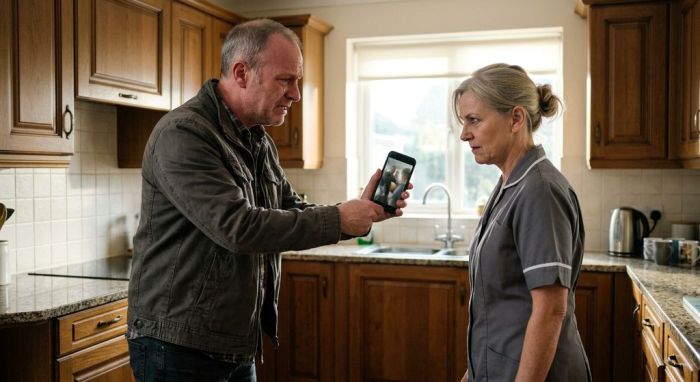
"Sign here, Eleanor," I said, holding up my phone. The video played. Her voice, cruel and commanding, telling my confused mother to sign away her rights.
She ran for the back door. The officers caught her before she reached the porch.
In her car, police found a spiral notebook with names, dates, bank account numbers, and the Social Security information of eleven elderly victims across three states. In her suitcase, they discovered forged wills, power of attorney documents, and a small bottle of clear liquid that lab tests later confirmed was lorazepam — a sedative capable of causing confusion, memory loss, muscle weakness, and eventually respiratory failure in elderly patients.
My mother had been slowly sedated every night for five months. The dementia-like symptoms I had been watching? Some of them were real. But some of them were chemical.
At the trial, seven other families testified. Their parents hadn't been as fortunate. Two women and one man had died with Carol Ann Mercer by their bedside, listed as beneficiaries in newly revised wills that had been signed under sedation. The prosecutor called her a predator who weaponized the trust of vulnerable families.
Carol Ann Mercer was sentenced to thirty-seven years in federal prison for fraud, forgery, identity theft, and attempted murder.
My mother lived another four years. She never fully understood what had happened — the real dementia, combined with the damage from the sedatives, had taken too much. But in her rare moments of clarity, she would squeeze my hand and whisper, "I'm glad you came home, Mark. I always knew you'd protect me."
I did, Mom. Eventually.
Now I volunteer as a speaker at elder abuse awareness programs across Ohio. I tell my story to anyone who will listen. I tell them to check the references personally. Install cameras from day one. Trust their instincts when something feels wrong. And never, ever ignore the small red flags.
Because the Carol Ann Mercers of the world are still out there. Smiling. Holding hands. Waiting for you to look away.
And when you do, they try to erase everything.