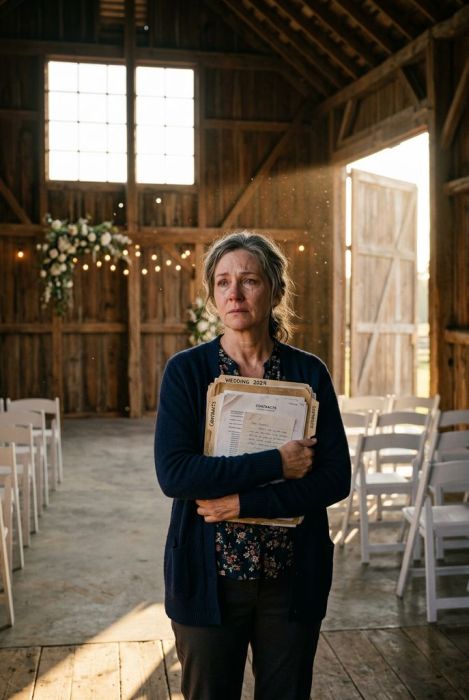
The Sunday it all fell apart, I was standing at the back of the fellowship hall holding thirty-one years of church ledgers in a cardboard box, and Clay Redmond was on the stage smiling like the sun. He had the microphone in his hand, and the whole congregation of Red Bluff Community Church was beaming up at him, the way they always did. I knew what he was about to say before he said it. I had known for nine weeks, ever since I found the first forged receipt buried in the building fund files.
My name is Nora Bellamy. I've taught American history at Red Bluff High for twenty-six years, and for almost as long I've been the volunteer treasurer and secretary here at the church. I keep the books. I count the offering. I write the thank-you notes to the widow who donates her late husband's savings every Christmas. I am the person nobody notices, and that is exactly why Clay chose me to betray.
Clay Redmond arrived eight years ago, fresh out of seminary school with a grin that could sell ice to Alaska. The youth group adored him. The elders trusted him. The women of the church—and some of the men—melted when he talked about the new building, the one we'd been saving toward for the better part of two decades. A new sanctuary with a proper nursery and classrooms for the kids. That was Clay's dream, and he made it everyone's dream.
The renovation fund had grown to almost a million dollars before he came. We were so close, and Clay made us believe the finish line was in sight. He started a capital campaign, gathered pledges, shook hands at every potluck. What I didn't know, what nobody knew, was that he was also quietly bleeding the fund dry.
It started with small things I might have excused. A renovation expense here, a contractor deposit there. The numbers never quite added up, but Clay was always so apologetic, always so grateful for my vigilance. "Nora, I don't know what this church would do without you," he'd say, and I'd feel foolish for doubting him.
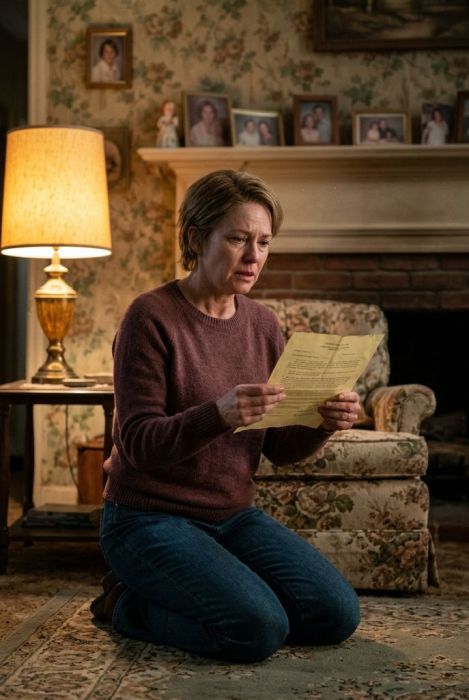
Then my mother got sick, and I took three months off to care for her. When I came back, the accounts were a disaster. The building fund had been gutted. Thousands of dollars missing, replaced by receipts for work that was never done, signatures that looked almost—but not quite—like real ones.
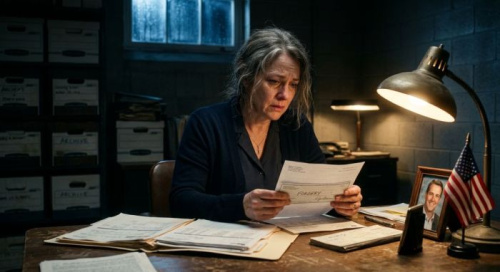
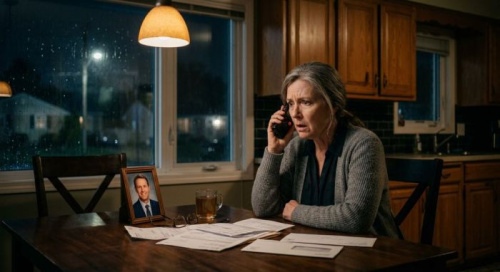
I spent three weeks going through everything at night, when the church was quiet and the only sound was the hum of the old furnace. I compared handwriting. I called the contractors listed on the invoices. Half of them had never set foot in Red Bluff. The other half had been paid, once, for a fraction of what the receipts claimed.
And there, at the center of it all, was Clay Redmond's signature—not once, but on forty-seven separate documents. I had proof. I had more than proof. I had enough to send a man to prison for a very long time.
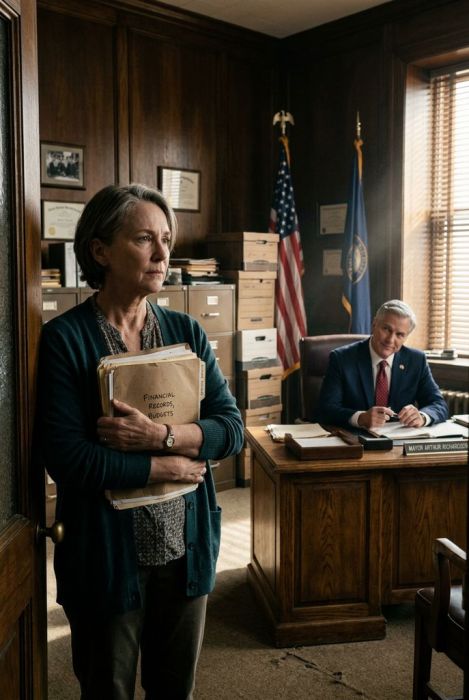
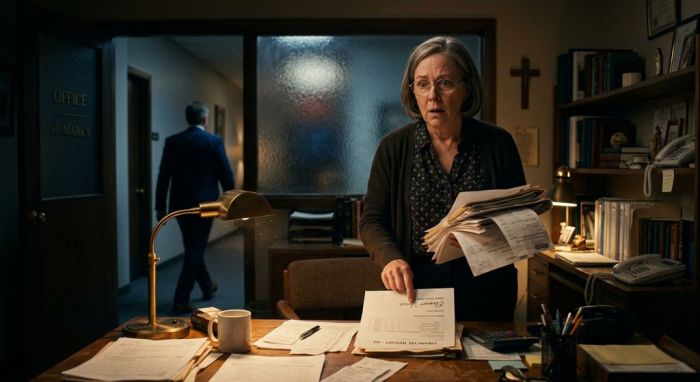
But I made the mistake of confronting him privately, with the courtesy I thought our years of friendship had earned. I met him in the church office on a Tuesday night and laid the receipts out on the desk between us. I expected shock, or denial, or even tears. Instead, Clay smiled.
"Nora," he said softly, "you've been under so much stress lately. Everyone can see it. Your mother, the school, that age of yours. People worry about you."
My blood ran cold. I understood in that instant that he had already planned for this exact moment. Clay Redmond hadn't just been stealing money. He had been laying the groundwork, weeks ahead, to make me look like the thief.
Over the next month, the rumors started. I heard them in the church parking lot, at the grocery store, in the teacher's lounge. That I was confused. That I'd been "off" since my mother passed. That the church finances were a mess and everyone knew whose fault it was. Clay never accused me directly, not once. He was too clever for that. He just looked sad and worried every time my name came up, and that was worse than an accusation.
The elders, all good and decent men who trusted Clay completely, decided to hold a special meeting. I was asked to step down from the books. I was told, gently but firmly, that I had been under strain and that the church needed a "fresh set of eyes."
And so, on that Sunday, Clay took the microphone while I stood in the back with my box of proof, and he announced to the entire congregation that the building fund had suffered a "tragic shortfall" due to "accounting irregularities." He didn't say my name. He didn't have to. Everyone turned to look at me.
You don't forget that feeling—three hundred people you've served for decades, suddenly looking at you like you're a criminal. My hands were shaking. My cheeks were burning. And Clay Redmond looked at me across that room with the sweetest, saddest smile I have ever seen, and I knew he had won.
Except for one thing. I had made a decision the night he first smiled at me across that desk, the night I realized the kind of man I was dealing with. I had stopped trusting the church's old accountant, a friend of Clay's, and I had driven three towns over to a forensic accountant named Margaret Sayers. And I had done something else, something quiet and ordinary that would end up saving me.
I had kept every photocopy. Every receipt. Every bank statement. Every email. And I had started recording my conversations with Clay.
The first time I played one of those recordings for Margaret, she went very still, then she leaned forward and made me play it again. What Clay had said to me in that office, so confident and cruel, was the confession I needed. With the forged documents and the trail of phantom contractors, it was enough for her to swear out an affidavit. It was enough to get a meeting with Detective Linda Torres, who listened with an increasingly set jaw and told me, in a voice that meant business, to keep doing exactly what I was doing.
I won't lie and say the next weeks were easy. The congregation turned on me. Friends I'd known my whole life crossed the street when they saw me coming. Clay had done his work well. He had made them all believe I was the villain, and worse—that I was a sad, confused old woman to be pitied and distrusted.
But I kept going to that same church every Sunday, because walking away would have made me look guilty. I sat in my usual pew, third row, under the hard stare of people who had once loved me. And every Sunday, Clay preached a little sweeter, smiled a little brighter, and watched me suffer.
The end came at a town-hall-style meeting Clay himself called. He wanted to announce the "restructuring" of the finance committee and unveil a new fundraising push to "restore the fund." He invited the local newspaper. He wanted a victory.
I walked in carrying the folder Margaret had prepared, and Detective Torres was two steps behind me. When Clay took the stage and began to tell the packed hall about the great new chapter ahead, I stood up from my seat.
"I'm sorry to interrupt, Clay," I said, loud enough for everyone to hear. "But I have something to show the church."
He laughed, warmly, indulgently, playing the part to the last. "Nora, please, we've all been worried about—"
I held up a single receipt, the first one I'd ever found, and I read the contractor's name aloud. "Do you remember this man, Clay? He says he's never done a single hour of work for this church."
The room went quiet. Clay's smile flickered, just for a second, and in that second I saw the fear underneath all that charm. Detective Torres stepped forward. Margaret handed her the affidavit. And I pressed play on the recording of Clay's voice, the one where he told me I was "of that age" and the church would believe him over me.
I watched the color drain from his face while his own words played for the whole town to hear. I watched the elders' expressions shift from confusion to horror as they recognized the truth. And I watched Clay Redmond, the golden boy of Red Bluff, get handcuffed in front of everyone he'd ever charmed, charged with felony fraud, embezzlement, and identity theft.
The trial lasted six weeks. The evidence was overwhelming. The detective had found additional accounts in Clay's name, four properties bought with stolen money, and two dozen other victims—including three families whose funeral funds he'd quietly redirected into his own pockets. He was convicted on all counts and sentenced to twenty-two years in federal prison.
The church didn't recover overnight. It took years, and it took a lot of humble apologies, starting with the elders who had believed him over me. But they rebuilt, and this time the building fund was overseen by a committee of five, with every invoice signed by two people and reviewed by an outside auditor every quarter.
As for me? I stayed. I kept teaching history, and I kept the books, though never alone. The congregation, once it understood the truth, did everything it could to make amends. They threw me a luncheon. They named a new classroom after my mother. And the day the new sanctuary finally opened—four years after Clay went to prison—they asked me to cut the ribbon.
I stood on that stage, in front of three hundred people who had once looked at me with suspicion, and I thought about the man who had tried to destroy me. I thought about everything he had taken, and everything he had failed to take. My name. My standing. My peace.
He didn't know, the day he smiled at me across that desk, that I'd spent thirty-one years writing down every receipt in that building, keeping every record because it was my job and my duty. He didn't know that kind of ordinary, patient, overlooked diligence is exactly what catches thieves in the end.
Some people think karma is a lightning bolt from the sky. It's not. Most of the time, karma is just a woman with a cardboard box of photocopies, a quiet voice, and enough patience to wait for the man who wronged her to smile one last time before the truth came down on him like the hammer of God. And when it does come down, it is the sweetest sound in the world.